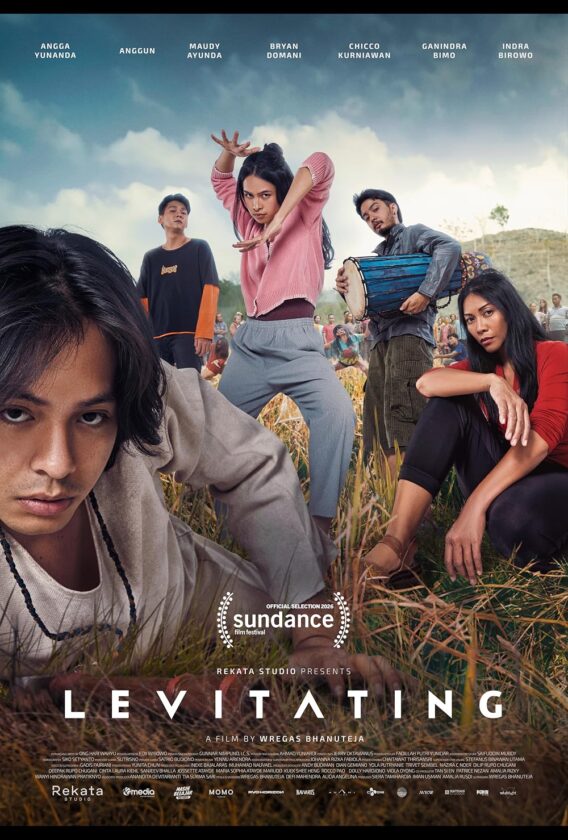
You may think you’ve seen Levitating before, but you haven’t. It sounds familiar, but it’s not. An Indonesian coming-of-age music competition drama, and the third film by director Wregas Bhanuteja, it has a lot of the tropes you expect, but it upends them by the novel inclusion of the film’s main hook: recreational spirit possession. Calling this a genre film sounds a tad inadequate though, not the least because this movie doesn’t neatly fit into a genre to begin with. Based in real-life cultural practices, it uses the supernatural to address issues of cultural conservation, corporate greed, and healing trauma, all while being massively entertaining and occasionally awe-inspiring.
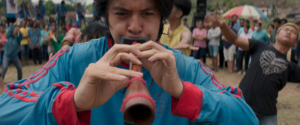
In the Indonesian village of Latas, the local youth population spend their recreational time at trance parties: through the music of a spirit-channeler, one of the village’s many animal spirits enters a person, putting them in a possessed state of otherworldly bliss. It’s a practice seen as childish, if not downright primitive by the city-dwellers in places like Jakarta, as well as the Wanaria corporation, who are looking to buy up Latas’ land, evict its residents, and replace the local culture with gentrifying real estate. Unfortunately, this includes the sacred spring that’s home to Latas’ spirits, on which they plan to build a hotel (which is likely also just an excuse take its water to sell en masse). Also unfortunately, the man who owns the spring is in dire need of money to save his son, which Wanaria is more than willing to provide.
During a trance party, Guru Asri discovers Bayu, a young man aspiring to be a spirit-channeler. Her channeling school is holding a massive trance party to raise the money to save the spring, and Asri wants Bayu to compete to be the head spirit-channeler at the event. However, Bayu’s divorced father is more than willing to sell his land to Wanaria in favor of starting a new business in Jakarta, even though his previous businesses there left him in massive debt and contributed to Bayu’s strained relationship with his dad. Bayu believes that if he wins the competition, the money from the trance parties will start rolling in and he’ll be able to avoid working in another family business. However, spirit-channeling requires intense mental concentration, and Bayu’s anxieties threaten to derail his chances.

For the most part, the film sticks to coming-of-age and music competition tropes pretty hard. Bayu is a despondent youth rebelling against his father by attending trance school instead of doing what his family wants. He attempts a relationship with Laksmi, a young woman working at a Wanaria poultry farm who is hoping to use trance dance to deal with prior trauma. There’s an arrogant opponent in the competition in the form of Ananto who, in contrast to Bayu’s anxiety issues, chugs heart-annihilating amounts of caffeine to aid in his spirit channeling. Yet the use of those tropes are also what I love about this movie, as all of them are turned on their head by the main topic of the film. For example, many of these stories involve an awkward introduction to the protagonist’s love interest, but how many of those movies have the two meet because he accidentally supernaturally dumped hot oil on her in the spirit realm?
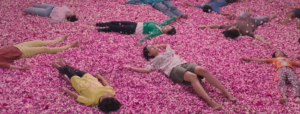
That said, the real selling point of this movie is the trance sequences. All the Sundance movies I saw this year I watched at home, and Levitating was a rarity for the festival: a film where I felt robbed watching on my TV. Now that I’ve seen it on the big screen at the New York Asian American Film Festival, I feel confident in saying that this movie needs to be seen in a theater. The trance scenes are absolutely incredible, combining powerful music, insane choreography, and top-notch filmmaking with a surprising amount of spectacle. We don’t just see these kids get possessed, we go into their heads to actually watch what they’re hallucinating, and there’s significantly more production value in those scenes than I expected. Honestly, some of the imagery on display is downright stunning. It’s hard to convey in an article, even more so since I want you to experience this film for yourself, but you’re just going to have to trust me.
In addition, some of the animal spirits even appear onscreen in CGI, enhancing the world of the film. Special mention should also be given to Anggun, who plays Guru Asri. A famous singer in Indonesia, she gives a powerhouse performance in terms of both acting and music. (At the Q&A I attended, the director said she improvised most of the mantras she chants on the spot based on the music, and in single takes.)

Yet while I’m sure the idea of escaping into a spirit realm with an animal friend sounds fun, the film makes it clear just how much risk can be involved. This is still a movie about spirit possession after all. While the movie portrays trance dance as a means to heal, when it goes wrong, people can get hurt. Not only through hallucinations, either. As part of the competition, the characters are put through some pretty intense physical extremes. Channel correctly, and getting beaten with rattan sticks can feel like a massage, but when you can’t concentrate on channeling, well…it feels like getting beaten. It adds real stakes to what’s happening in the film beyond the attempt to save the spring.

As much as this film adheres to tropes, that really serves to put the audience in a false sense of security for what’s to come. If there’s anything in this movie that stuck with me beyond the trance scenes, it’s the third act. To say this movie has a tonal shift would be too much of an understatement to put into words. Imagine Miles Teller’s character from Whiplash if instead of playing drums he was working with spirit possession. It’s actually significantly more insane than that. I’m not going to go into detail because, if there’s anything I don’t want to spoil, it’s this part, but I will concede that this portion of the film could prove divisive. However, I loved this turn, and unlike a lot of movies I’ve watched that similarly shifted tones, i thought it actually worked, and added to the film’s themes.

I went into Levitating solely based off of an intriguing premise and good word of mouth. What I got genuinely surprised me. It’s one of my favorite film discoveries so far this year, upending worn tropes through a powerful hook, while stressing the importance of cultural preservation and using spiritual practices to heal. It brings the unseen to glorious life through the power of filmmaking, creating an unexpected big screen experience in the process. If you have no idea what trance parties are, this will likely get you wanting to know everything about them afterwards, as it did me. As of this writing, Levitating doesn’t have U.S. distribution, which is an absolute shame. There is 100% an audience for this movie, and I hope it reaches them soon.