

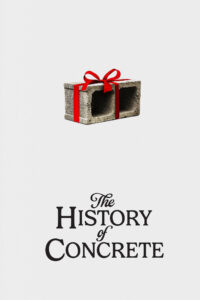
First things first: The History of Concrete is a documentary about concrete. It’s about a lot of other things too, like, a lot of other things, but it is still mainly about concrete. (It’s not even the first concrete documentary I’ve seen in the past two years. It is however, the superior one.) It’s safe to say that, for the already uninitiated, a movie about concrete is going to be a hard sell, and that’s is something that the film already has on its mind. However, there is one prominent selling point this film has, and that is the man behind it: John Wilson, one of the only people who can make a documentary about concrete that will actually hold your attention.

For three seasons and eighteen episodes, the HBO docu-comedy series How To with John Wilson presented its titular creator’s idiosyncratic view of everything from small talk to scaffolding to the absolute hell of parking in New York City, all told entirely from the point of view of John’s roving handheld camera and usually ending up several hundred miles from where it originally started. Despite not having a comedy background, John’s style nonetheless fits right at home with the awkward comedy and this-can’t-be-real storytelling of Nathan Fielder (who also produced John’s show), and the soft-spoken love of the mundane of Joe Pera (maybe the only other person who could make a documentary on concrete that would hold your attention). How To ended in 2023, and John’s certainly kept busy since then, including opening Low Cinema, a movie theater in Ridgewood, Queens. However, The History of Concrete marks his long-awaited return to documentary storytelling, this time on the big screen. The question is, though, how much is there to say about concrete? As it turns out, quite a lot.

Calling The History of Concrete “How to with John Wilson: The Movie” feels overly generalizing, but it’s also sort of accurate. Following the show’s ending, John finds himself dealing with a somewhat higher profile but also no longer having the support of a major corporate cable network. His royalty checks dwindling, he tries to find a way to get back to making documentaries. At some point during the Writers’ Strike, he attends a lecture on how to make a Hallmark movie. Learning the do’s and don’ts of basic cable easily-digestible romance, he decides to put that knowledge towards his next project: a documentary about concrete. John’s a New Yorker, after all, and concrete is ubiquitous, but nobody ever thinks about it. What better way to get people interested in concrete than a documentary on the subject that also works as a Hallmark movie?

I’ve said that How To with John Wilson was one of the only documentary shows I’ve seen where you had to watch it when it aired to avoid spoilers. It’s not so much about spoiling real-life events, but more the insane direction John took each episode in. Considering that, I’m gonna try and keep mum on some of this movie’s most jaw-dropping moments, except for what marketing has already revealed, but suffice it to say, How To fans will not be disappointed. John’s ability to capture incredible images and turn them into comedy gold is on full display here, as is his tendency to find himself in the most bizarre situations that, somehow, still find a way to make some sense in his ultimate thesis. First, let’s talk about the titular building material. The film does in fact have a lot of say about concrete, and yes, even some of its history. John even finds some of the material’s most interesting soldiers, such as a “Gum Buster” who vaporizes the gum on the sidewalk, and an entire concrete convention that also includes a high-energy bricklaying competition.

Yet, the most surprising thing about The History of Concrete is just how urgent a lot of it feels. Some of the things covered in the documentary are honestly terrifying to think about, with concrete encompassing multiple problems of the modern world. I’ve been pretty nervous walking under scaffolding ever since I watched the How To episode on it, and this film carries film similar threads. John manages to combine several dimensions of social issues into the topic of concrete in ways that I was really impressed by. Concrete isn’t the only thing on this film’s mind, though. In fact, The History of Concrete doubles as a melancholy meditation in the current state of making art itself. The whole basis of the movie, that it’s a documentary about concrete, becomes a treatise on the problems of film financing, market-driven thinking, and who to create for that couldn’t feel more relevant, and is especially troubling given the film’s urgency.

If I had a criticism, it’s only that it’s possible that the wandering style of How To might be a bit much at 101 minutes, but that feels minor, and might vary depending on the viewer. Who John interviews and what directions the movie ends up taking I’ll leave you to experience for yourself, but I’ll say this: at a certain point, when everything clicked, I really couldn’t believe some of what John was doing, and the film ultimately comes together on an absolutely beautiful note. If you’re a fan of How To with John Wilson, this is an absolute must-see. If you’re not, or aren’t already, there’s still enough in here I hope gets your attention. In fact, I may never walk down the streets of New York City the same way again.